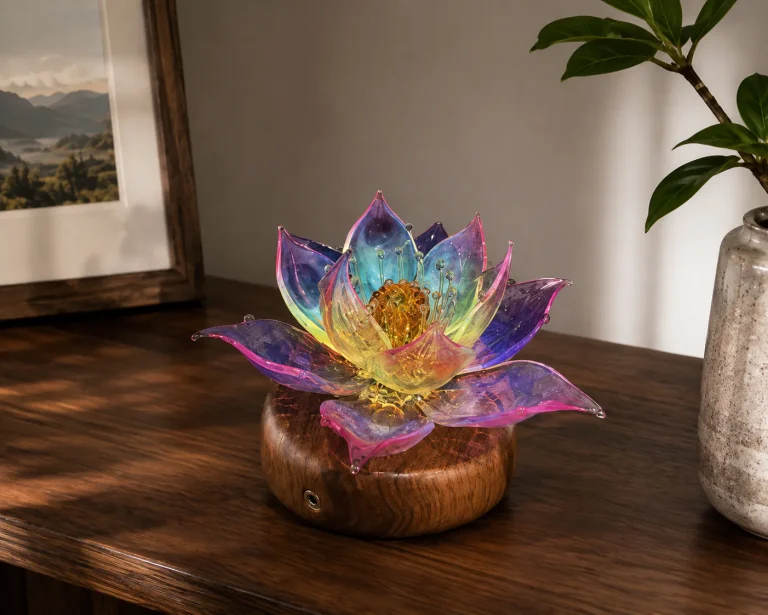
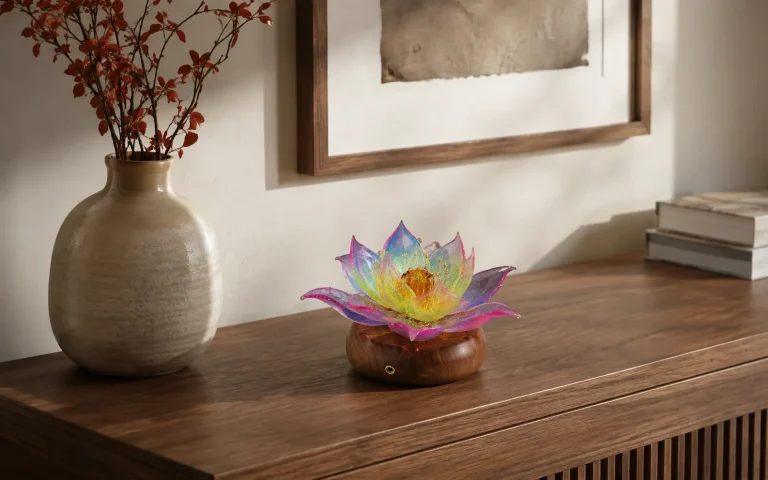
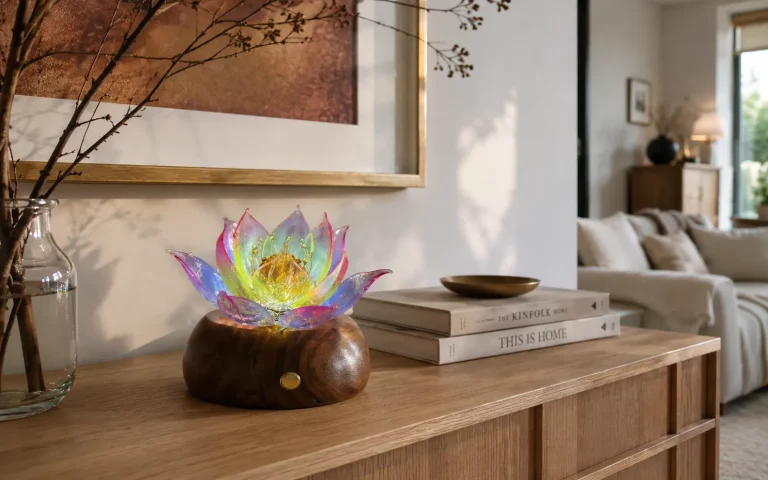
Two handmade glass lotus lights may follow the same design and still never appear completely identical. For example, one petal may curve slightly higher, while a color transition may sit closer to the edge. The center may also reveal more depth from one viewing angle and greater transparency from another.
These differences do not come from a printed surface or repeated mold. Instead, they begin during the lampworking process, when an artisan heats, shapes, layers, joins, and assembles borosilicate glass by hand.
Therefore, this article explains what lampworked borosilicate glass is, why it suits the structure of a glass lotus, which variations are normal, and how internal light reveals details that may remain almost invisible during the day.
What Is Lampworked Borosilicate Glass?
Lampworking is a glass-forming technique that uses a controlled flame to soften glass rods and components. The maker then uses tools, gravity, rotation, and hand movement to shape each part at close range.
9Purple artisans use modern borosilicate glass for lotus petals, stamens, buds, stems, and small structural details. Because the artisan works on individual components, the flower does not depend on one fixed decorative mold.
In addition, the term Liuli-inspired describes the visual and cultural language of the collection. It does not mean that these pieces use kiln-cast ancient Liuli. Instead, they are contemporary decorative objects made from borosilicate glass through lampworking.
Glass Softens Gradually
Direct heat lets the maker work on a specific edge, tip, curve, or connection point without forming the entire flower at once.
Every Curve Is Guided
Hand movement, tool pressure, timing, and temperature influence petal width, lift, direction, and layering.
Parts Become One Object
The artisan assembles individual petals and details into a flower, creating a structure that differs from a repeated molded surface.
Why Every Glass Lotus Looks Slightly Different
For example, the artisan makes several decisions while shaping a handmade lotus. The artisan must determine how far a petal opens, where it overlaps the next layer, how the tip turns, and how the flower remains balanced as the glass cools.
However, even when the artisan follows the same color palette and general dimensions, heated glass does not behave like a rigid prefabricated part. Small changes in temperature, timing, movement, and assembly naturally influence the finished piece.
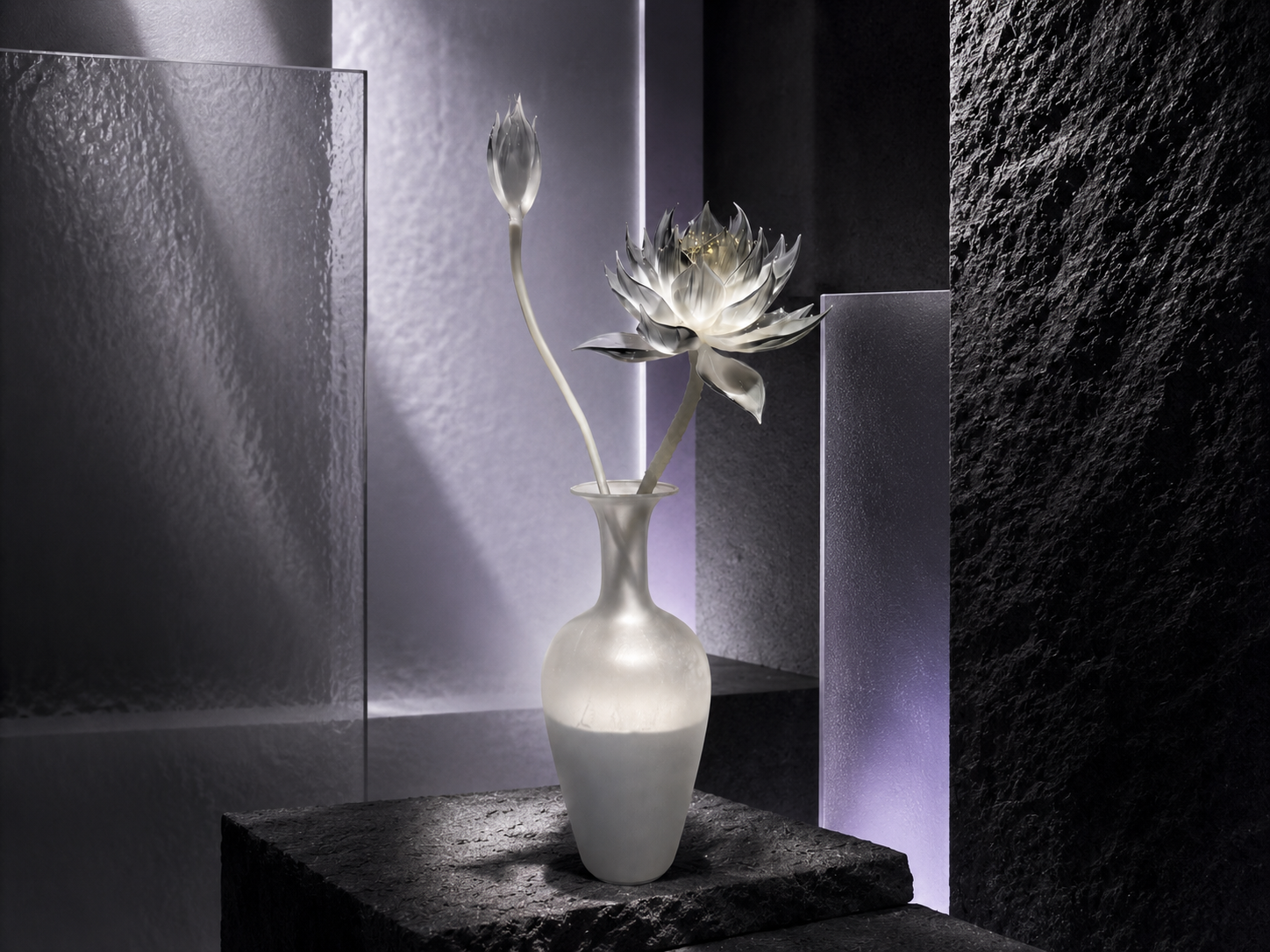
Six Handmade Variations You May Notice
- Petal curve: one petal may lift, open, or turn slightly differently from another.
- Layer spacing: the distance and overlap between inner and outer petals may vary subtly.
- Color transition: gradients may travel farther through one area of glass or appear stronger near an edge.
- Transparency: differences in thickness and layering can change how much light passes through a particular section.
- Surface and internal detail: fine tool marks, slight texture, or small internal bubbles may remain visible in handmade glass.
- Overall balance: the completed flower follows the same design identity without becoming a mechanically identical duplicate.
Variation Is Not The Same As Damage
Handmade variation describes small differences in shape, color, translucency, texture, and assembly. These differences do not prevent the object from functioning or displaying correctly.
By contrast, a broken petal, major crack, separated component, unusable base, or confirmed functional defect counts as damage. Customers should document and report those issues according to the 9Purple Refund & Return Policy .
How Color Becomes Part Of The Glass
Color In Daylight And After Dark
A molded or surface-painted object may carry most of its color on the exterior. Lampworked glass works differently. While the material remains hot, the artisan can layer, stretch, overlap, or join colored glass within the structure.
As a result, color may appear differently across the same lotus. A pink edge may become softer toward the center. Blue-white glass may look pale in daylight but more defined after illumination. Meanwhile, smoky glass may reveal warm internal reflections that remain subtle when the light is off.
Therefore, the final appearance depends on more than a named color. Glass thickness, transparency, neighboring layers, viewing angle, daylight, and the internal light source all influence the result.
How Internal Light Reveals The Handmade Structure
Why The Light Remains Localized
In addition, the internal light in a 9Purple glass lotus does not aim to illuminate an entire room. Instead, it helps the viewer see the glass construction more clearly.
When the light switches on, thicker areas may hold more color, while thinner edges transmit more light. Overlapping petals also create secondary shadows. At the same time, transparent sections allow the center and lower layers to remain visible through the flower.
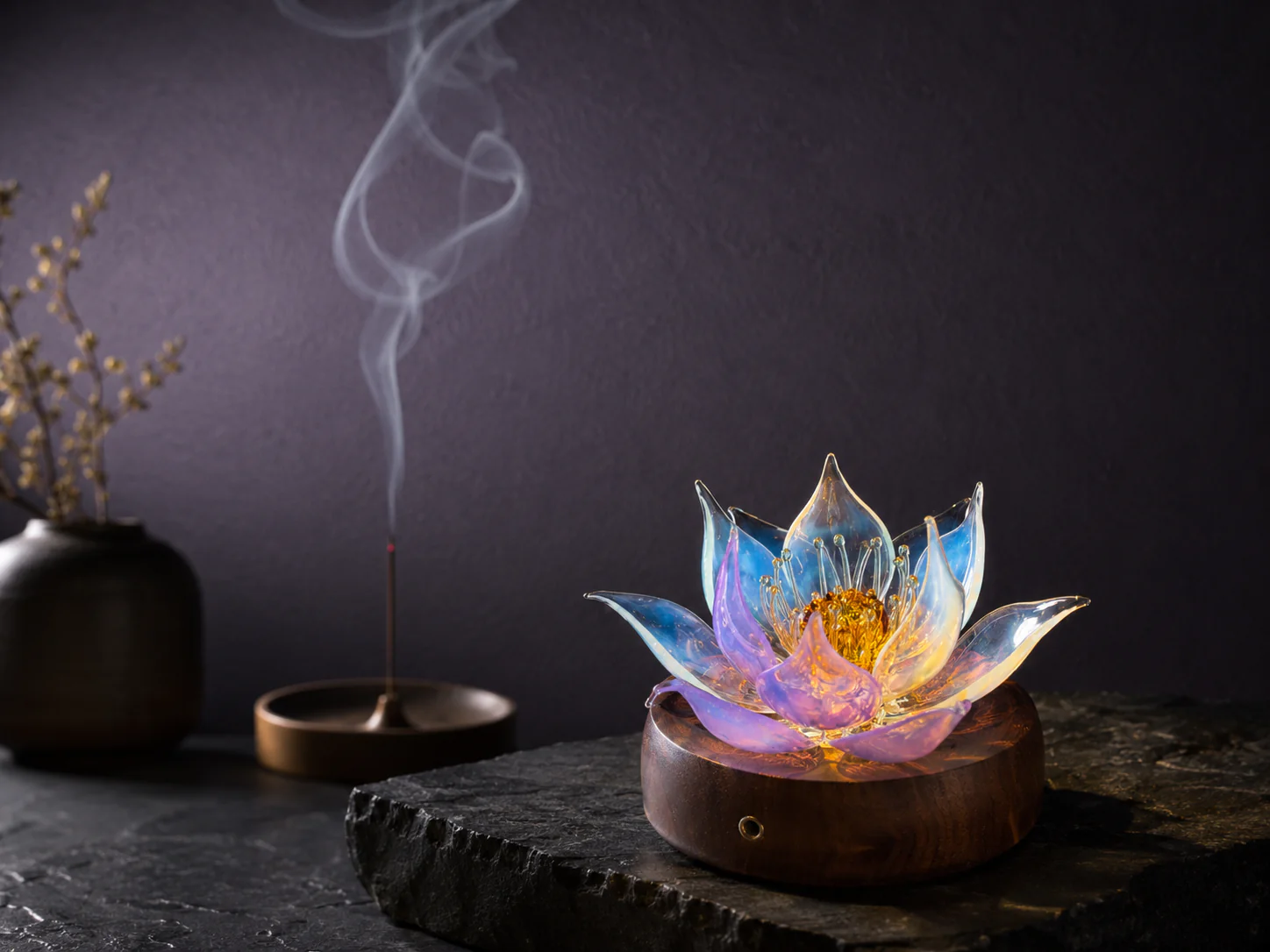
Consequently, the same object can appear quieter during the day and more visually active after dark. The flower itself remains unchanged, but the light reveals different parts of its structure.
Lampworked Glass Versus Molded Decorative Glass
A Useful Comparison Before Buying
By contrast, not every object described as a glass lotus follows the same production method. The main difference does not simply concern whether an object contains glass. Instead, it concerns how the maker creates the form, color, and individual components.
| Feature | Lampworked Borosilicate Glass | Typical Molded Decorative Object |
|---|---|---|
| Forming method | The artisan softens components in flame and shapes them with tools and hand movement. | Manufacturers usually repeat the overall form with a fixed mold or standardized component. |
| Petal structure | The artisan makes, positions, and joins petals as separate structural elements. | A repeated surface may reproduce several petal shapes at once. |
| Variation | Expect small differences in curve, overlap, thickness, and color. | Manufacturers generally aim for a highly uniform appearance. |
| Role of light | Light reveals transparency, layering, edges, and internal glass detail. | The lighting effect may function separately from the material or dominate the design. |
| Object identity | Each piece follows the same design while retaining individual handmade differences. | Each unit generally repeats the same standardized appearance. |
Nevertheless, this comparison does not mean that every molded object has poor quality. Likewise, borosilicate glass alone does not guarantee a successful object. Design, shaping control, assembly, finishing, inspection, and structural integrity also affect the final quality.
Why Borosilicate Glass Suits The Lotus Form
Why Transparency Matters
A lotus contains several visible layers: an outer silhouette, inner petals, a center, and changes in openness from one level to the next. Transparent glass allows the viewer to see those layers instead of reducing the flower to one solid block.
Moreover, borosilicate glass lets the artisan work on relatively fine components and connections. This supports thin petal edges, upright center details, layered structures, curved stems, and small transitions between clear and colored sections.
Therefore, the finished object does not attempt to imitate a natural flower perfectly. Instead, it translates the recognizable lotus structure into a durable decorative object defined by glass, light, color, and handmade assembly.
What To Check Before Ordering A Handmade Glass Lotus
1. Understand The Lighting Purpose
A glass lotus light creates localized atmosphere. Customers should not purchase it as a replacement for a reading lamp, desk lamp, or primary room light.
2. Allow For Handmade Variation
Product photographs show the intended design, color family, and overall structure. However, the exact position of every curve, color transition, and internal detail will naturally differ.
3. Check The Placement Area
Compact lotus light models measure approximately 12 × 12 cm. Therefore, place them on a stable bedside table, shelf, study desk, or side table where people will not easily knock the petals.
4. Review Made-To-Order Terms
9Purple begins making each glass object after the customer places an order. Confirmed made-to-order glass purchases are final sale except in verified cases of transit damage, confirmed defect, or an incorrect item.
5. Compare The Color Expressions
Finally, choose Lunar for the palest and calmest expression, Aurora for balanced cool color, Noir for smoky depth, Prism for the strongest multicolor presence, or Rosefire for warmer pink-purple tones.
Choosing The Object For Its Material, Not A Perfect Duplicate
Ultimately, buying a handmade glass lotus differs from choosing an identical machine-produced object. The product page establishes the design, size, materials, color direction, base, and intended function. Meanwhile, the individual piece carries the final decisions made during shaping and assembly.
For many customers, this natural variation provides the main reason to choose handmade glass. It gives the object an identity connected to the production process rather than to a perfectly repeated mold.
To compare the current lotus colors, room uses, dimensions, lighting purpose, and studio glass vase object, visit the complete 9Purple Glass Lotus Decor guide .
Explore The Glass Lotus Collection
Compare Lunar, Aurora, Noir, Prism, Rosefire, and Vermilion Rose by color, room atmosphere, placement, and visual presence.
View Glass Lotus DecorFAQ: Lampworked Borosilicate Glass
What is lampworked borosilicate glass?
Lampworking uses a controlled flame, hand movement, and tools to shape borosilicate glass. The artisan can form and join individual parts rather than producing the entire decorative object from one repeated mold.
Are all 9Purple glass lotus lights identical?
No. They follow the same product design, color direction, dimensions, and structure. However, each piece may show small differences in petal curve, layering, transparency, color transition, texture, and internal detail.
Do small bubbles in handmade glass count as defects?
Small internal bubbles can occur during handmade glass production and do not automatically indicate a defect. By contrast, customers should report a major crack, broken component, separated structure, or functional failure.
Why can the glass color look different when the light is on?
Internal light passes through areas with different thicknesses, transparency levels, color layers, and overlaps. As a result, edges, gradients, shadows, and internal details may appear stronger after dark.
Is lampworked glass the same as kiln-cast Liuli?
No. 9Purple uses modern borosilicate glass and lampworking techniques for its glass lotus objects. “Liuli-inspired” refers to visual and cultural language rather than traditional kiln-cast production.
Does borosilicate glass alone make an object high quality?
No. Material only forms one part of the finished result. Design, complexity, shaping control, assembly, finishing, structural integrity, inspection, and presentation also influence quality.
Where can I compare the different lotus colors?
The Glass Lotus Decor collection guide compares Lunar, Aurora, Noir, Prism, Rosefire, and Vermilion Rose by color, placement, lighting purpose, and room atmosphere.