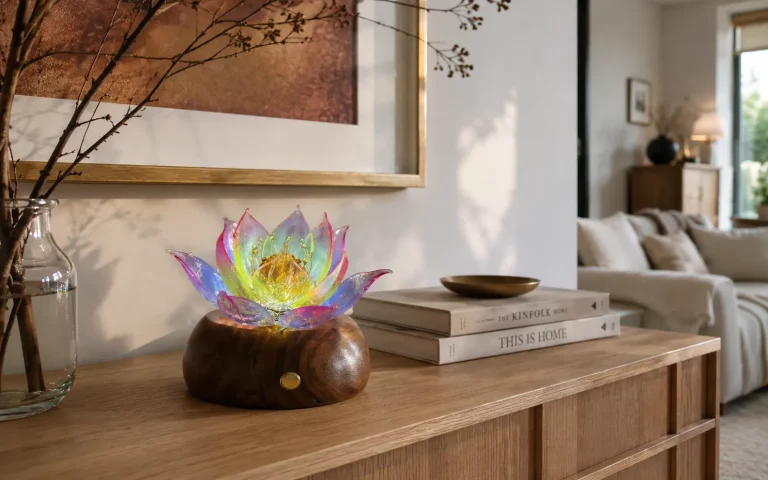
Meaningful Objects. Modern Stillness.A visual anchoris the immediate coordinate of calm that provides the hyper-stimulated eye with a structured place to rest, while everything else in the modern landscape remains in accelerated motion. Contemporary professionals spend their waking hours navigating glowing screens, multiplying digital browser tabs, and processing urgent messages arriving long before the previous thought has fully crystallized. This weightless digital friction induces a profound mental exhaustion, calling for physical artifacts that project absolute visual stability.
An authentic natural stone placed on a minimalist workspace is never there for mere superficial luck or superstition. Instead, it operates explicitly as a Visual Anchor — an uncompromising physical point of stillness designed to interrupt the cognitive strain of a fluid virtual environment.
 Atmosphere: The Gravity of Space
In many ways, hyper-efficient digital corporate life entirely deprives the human body of physical permanence. We trace glass screens, shift weightless pixels, and manage invisible metadata stream for hours. While this experience maximizes institutional velocity, it leaves the somatic system strangely depleted. This is precisely the psychological engine driving our visceral attraction to raw earthly elements: a cold mineral specimen, a weighted bracelet, or a dense stone edge touched during a high-stakes board meeting. In these moments, the hand actively searches for tactile grounding long before the conscious mind can articulate its need for relief.
Similarly, clinical grounding practices restore focus by returning attention to immediate environmental realities. A masterfully sculpted artifact executes this exact function by offering wandering cognitive attention a reliable point of return. For a comprehensive general reference on spatial stress regulation, see this Harvard Health overview of grounding techniques.
Your body notices before your mind explains it.
Why a Visual Anchor Gives the Eye a Place to Rest
An over-congested desk does far more than occupy physical square inches; it forces the eye into a state of perpetual reaction. Exposed plastic cables, split computer monitors, scattered analytical notes, and half-finished commercial packages generate a continuous torrent of visual noise. Cultivating a dedicated Visual Anchor completely transforms that environmental dynamic. For the human optic nerve, a high-design object serves as a profound structural full stop — something solid, entirely quiet, and completely free from the obligation of digital interaction.
In contemporary digital interface architecture, visual focus and cognitive load dictate how information is parsed and how human attention moves. However, physical spatial architecture answers a much more ancient, primitive mandate: when the field of vision contains no explicit area of rest, the subconscious mind is forced to scan continuously, compounding cognitive exhaustion. See related research on visual attention and cognitive load. Because of this, masterfully crafted jewelry and objects mutate from superficial decoration into vital environmental architecture. An object placed with intent on a desk, or worn on the skin, draws a sharp protective boundary between ambient chaos and internal stillness.
 Texture: Natural Stone & Subtle Metal
How a Visual Anchor Reduces Spatial Noise
Visual noise is not merely physical clutter; it is the exhausting psychological sensation that too many disparate signals are demanding to be processed simultaneously. A glowing monitor, an aggressive power cord, a hyper-saturated consumer package, and an incomplete reminder note all violently yank focus in opposite directions. Therefore, a visual anchor operates by providing human attention with one singular, completely stable coordinates to land upon. It carries no necessity to loudly dominate the architecture of a room. In fact, the most potent anchors are intensely low-key, minimal, and anchored in pure material presence.
This is precisely why natural volcanic obsidian, matte minerals, and plum-toned architectural metals feel radically distinct from synthetic corporate materials. Their unique light-absorption and density instinctively slow the movement of the eye. As a direct consequence, the overarching space immediately feels less scattered, transitioning the room into an intentional space.
The Somatosensory Fidgeting Impulse
Have you ever found yourself unconsciously spinning a heavy gemstone ring or sliding a bracelet along your wrist during a high-stakes corporate negotiation?Although this somatic movement appears minor on the surface, it is rarely a meaningless accident. Physical repetition provides the nervous system with highly predictable, reassuring data, while the weight of the material gives the brain a physical signal of certainty. The object effectively becomes a private ritual of rhythm insulating you from a noisy environment. For this reason, the exact surface texture of an object dictates its emotional utility. A polished natural mineral, a raw textured crystal, or the cold weight of gold-plated elements becomes a quiet sanctuary for touch. You engage with it once, then again, allowing the body to down-regulate ambient anxiety.
At 9PURPLE, we engineer meaningful jewelry to navigate seamlessly between the boundaries of body and space— masterfully worn on the active pulse, placed on a raw brutalist slab, or kept close during professional moments that demand unshakeable steadiness.
Objects That Ground the Atmosphere of a Room
Certain contemporary rooms feel deeply unstable because absolutely nothing within them carries physical gravity. There is an overabundance of harsh fluorescent lighting, an excess of cheap plastic mold, and too many surfaces engineered to feel lightweight and disposable. Introducing a single high-density object completely alters that spatial physics. Gradually, the human gaze begins to slow down, and the entire atmosphere feels structurally centered. Rather than filling an interior with an accumulation of things, the design objective should be selecting one singular object that makes the environment feel less scattered.
A heavy dark stone projects a profound sense of environmental protection, while clear, architectural materials render a crowded desk lighter. Meanwhile, a warm, hand-finished metal detail effortlessly softens a cold clinical setting. Together, these meticulous choices govern what brand of emotional atmosphere remains close to your body throughout the working day.
 Ritual: The First Moment of Contact
Curating What Enters Your Personal Sanctuary
Many design-savvy professionals and minimalists ruthlessly simplify their surroundings following intense chapters of emotional or digital exhaustion. Consequently, they reject loud, hyper-stimulating accessories and begin selecting objects that project deep visual stillness and material permanence. This is the quiet, transformative mandate of a Visual Anchor. A calm, intentional object makes no theatrical promises to alter your external destiny. Instead, it stands as a constant, non-negotiable physical reminder of exactly where your focused attention belongs.
A visual anchor can comfortably manifest as a curated gemstone bracelet, an raw mineral specimen, a glass vessel, or even a completely cleared negative space on a shelf. What matters is never the commercial price of the artifact; rather, it is whether the object provides the eye with an unshakeable, utterly reliable coordinate to return home to. To understand how this spatial principle translates directly into personal wearable artifacts, explore our curated study on premium natural stone bracelets.
We need better reasons for keeping them close.
Visual Anchor: Common Questions
What is a Visual Anchor?
A Visual Anchor is an intentionally selected physical object that provides the human eye and mind with a reliable, stable point of focus. Within a visually noisy or digital environment, it anchors focus and creates spatial stillness.
Why does the human eye require a place to rest?
The eye requires an explicit area of rest because continuous, un-anchored visual stimulus forces the brain into constant reaction. A deliberate focal point halts this scanning reflex, lowering cognitive load and returning the mind to stillness.
Why do individuals touch the same object repeatedly during anxiety?
Repeated somatosensory contact creates a stabilizing neurological baseline. A premium gemstone ring, bracelet, or heavy wood edge provides the body with highly predictable sensory feedback during chapters of mental or digital overload.
Why do high-density materials feel intrinsically calming?
Weighted materials deliver a powerful sensory contrast against the weightless, temporary surfaces of digital life. Authentic natural stone and precious metals provide immediate, honest thermal and mass feedback to ground attention.
How does 9Purple integrate this philosophy into product design?
9Purple engineers meaningful wearable pieces and decor items with strict material presence, visual stillness, and everyday ritual in mind. Every mineral is selected to act as an unshakeable point of presence close to the body.