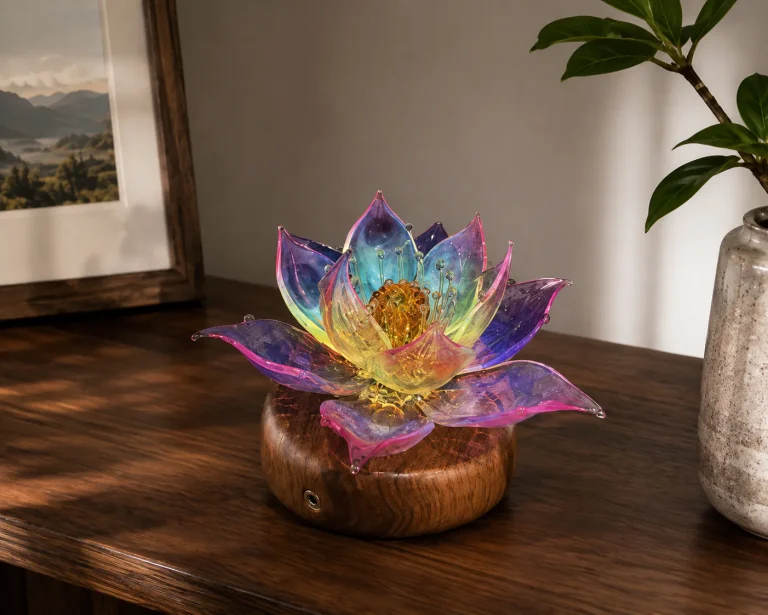
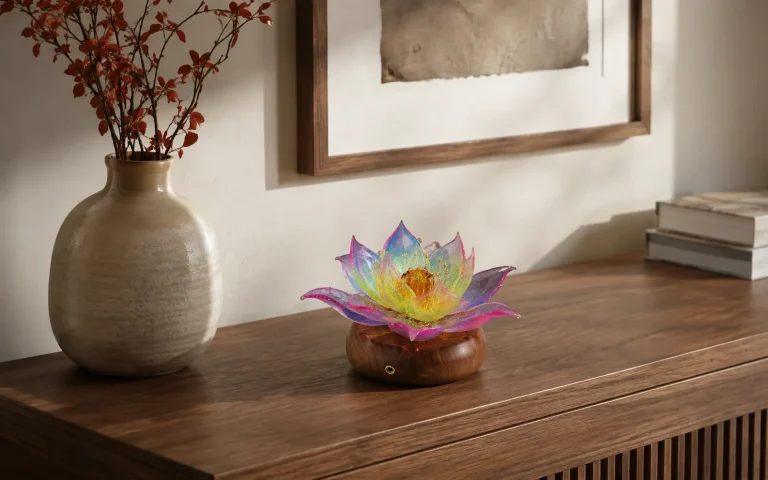
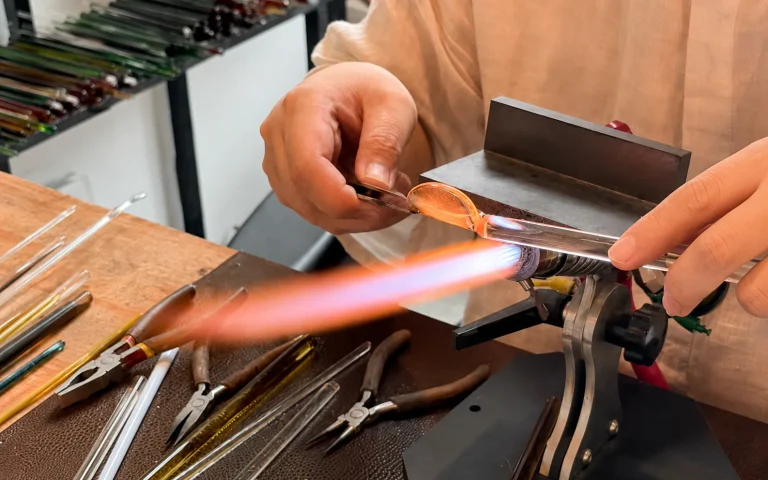
A glass lotus light does not need to sit at the center of a room to be noticed. In most interiors, it works better on a stable surface slightly outside the main activity area—somewhere the glass remains visible without competing with books, cables, or other everyday objects.
At the same time, the right placement needs to work in two conditions. During the day, the lotus is a handmade glass object defined by color, transparency, and petal structure. In the evening, its internal light reveals another layer of detail and adds a localized glow to the surrounding surface.
In this guide, we look at practical glass lotus light placement in a bedroom, study, and living room. More specifically, the following sections cover viewing height, usable surface space, nearby objects, lighting expectations, and common placement mistakes.
Start With Four Placement Principles
Before deciding whether the lotus belongs on a bedside table, desk, shelf, or console, it helps to establish four basic placement principles.
Choose a Stable, Uncrowded Surface
Use a flat surface with enough depth for the full walnut base. Keep the lotus away from the front edge and avoid surrounding it with many small objects of a similar scale.
Keep It Within a Natural Line of Sight
The best position is often slightly outside the main activity area: visible during normal use of the room, but not blocking work, reading, movement, or conversation.
Leave Space Around the Petals
Make sure nearby books, vases, shelves, or wall objects do not cut into the flower’s outline from the main viewing angle.
Consider Daylight and Evening Glow
Choose a position that works when the light is on and off. Soft daylight reveals the glass structure, while evening light brings out the internal glow.
Choose a Stable, Uncrowded Surface
First, place the glass lotus on a flat, stable surface with enough depth to support the full walnut base. In particular, avoid positioning it close to the front edge of a table in areas where people regularly reach for books, drinks, phones, or remote controls.
Although the surface does not need to be empty, it should not be crowded with many small decorative objects. Because the lotus already has a detailed outline and layered glass structure, similarly sized objects can make the petals visually disappear and cause the arrangement to feel busy.
Instead, leave one clear zone around the flower and limit nearby objects to one or two supporting pieces.
Keep It Within a Natural Line of Sight
However, the most effective position is often not the most central one.
Ideally, a glass lotus light should sit where the eye naturally passes during normal use of the room. For example, this might be the inner side of a bedside table, the back corner of a study, a console behind a sofa, or a shelf visible from a favorite chair.
At the same time, the object should remain noticeable without interrupting the main function of the space. In a study, it should not block a monitor; in a bedroom, it should not take over the entire bedside surface; and in a living room, it should not obstruct conversation or movement.
Leave Space Around the Petals
In addition, the outer petals need enough visual space to remain readable as a complete flower.
For this reason, avoid placing the lotus directly against a tall stack of books, a large vase, or a wall object that overlaps its silhouette. A little distance between the petals and nearby objects helps the glass edges remain visible, especially when the light is turned on.
In practice, this does not require an exact measurement. From the main viewing angle, you should be able to see the full outline of the flower without surrounding objects cutting into it.
Consider Both Daylight and Evening Glow
Finally, a successful placement should work both when the lotus is illuminated and when it is not.
During the day, attention shifts to the transparency of the glass, the color transitions between petals, the handmade irregularities, and the relationship between the flower and the walnut base. By contrast, the internal light becomes more prominent in the evening and reflects softly onto the table or nearby wall.
Therefore, avoid choosing a position that only looks convincing in darkness. Even when switched off, the lotus should still feel like a considered glass object.
In addition, avoid prolonged exposure to intense direct sunlight. Strong sun can create excessive glare, make the colors difficult to see, and produce unnecessary heat around decorative objects.
Glass Lotus Light Placement in a Bedroom
In a bedroom, placement should balance atmosphere with daily practicality. Although the lotus can add a localized evening glow, the bedside area still needs to function normally.
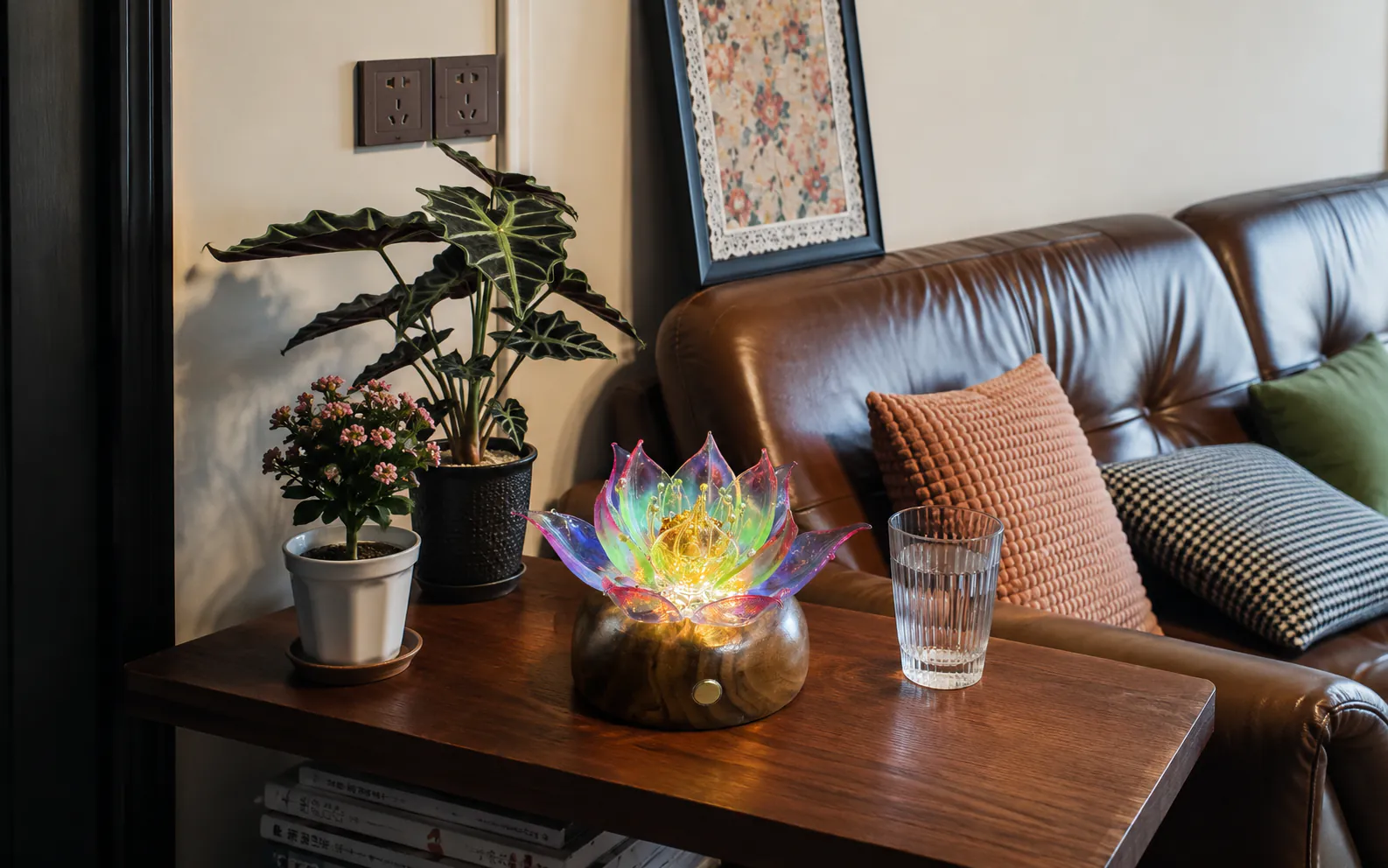
On a Bedside Table
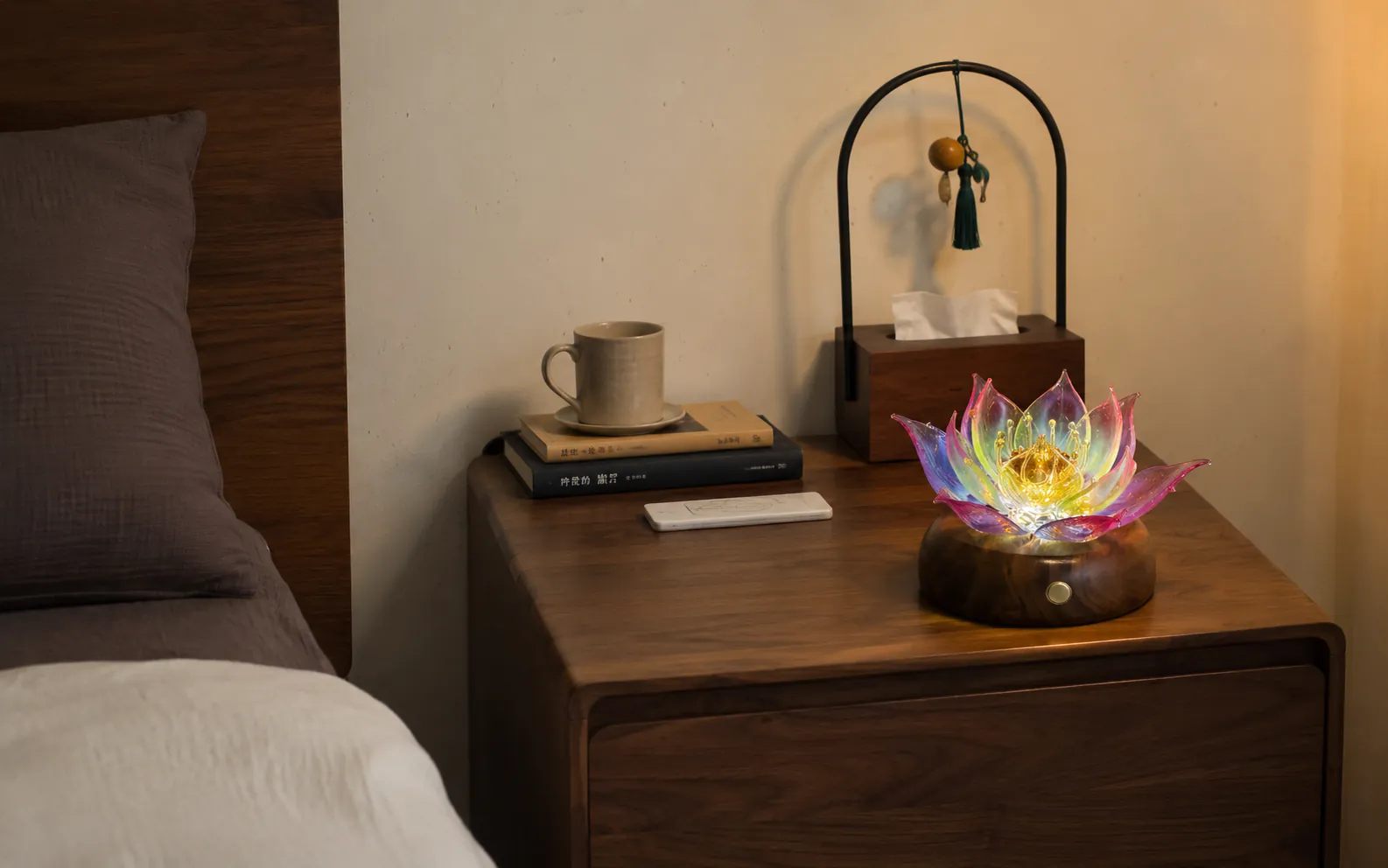
For most bedrooms, a bedside table is one of the most natural positions for a glass lotus light, provided the surface is wide enough to hold the base without crowding the rest of the table.
Rather than placing it near the edge, position the lotus toward the inner or rear section of the nightstand. This leaves the front section available for a phone, book, water glass, or other items used before sleep.
Meanwhile, keep the touch button easy to reach so that other objects do not need to be moved every time the light is turned on or off.
Nevertheless, the lotus should not be treated as the only reading light beside the bed. Keep a separate task light available when stronger, more directional illumination is needed.
On a Dresser or Low Cabinet
If the bedside table is too small, a dresser or low cabinet can be a better option.
In particular, this placement works well when the object can be seen from the bed without sitting directly beside it. The greater distance allows the lotus to function more as a small sculptural focal point than a bedside utility object.
Moreover, a dresser provides more surface area, making it easier to leave negative space around the petals. Pair the lotus with one low object, such as a tray, a closed book, or a small ceramic piece, rather than filling the entire surface.
Keep the Surrounding Objects Practical
Bedroom styling often becomes less convincing when every object is chosen only for decoration.
Instead, a book that is actually being read, a water glass, a phone, or a small personal container can make the placement feel more natural. The key is to leave enough usable space for daily routines.
At the same time, avoid surrounding the lotus with clusters of candles, crystals, ornaments, or multiple small lamps. The flower already contains color, detail, and light. As a result, it usually needs fewer supporting objects than a plain table lamp.
Glass Lotus Light Placement in a Study or Home Office
In a study, the lotus should support the visual rhythm of the room while remaining outside the main work zone.
Keep It Outside the Main Work Zone
To begin with, do not place the lotus between the keyboard and monitor, beside frequently moved documents, or anywhere that reduces the practical working area.
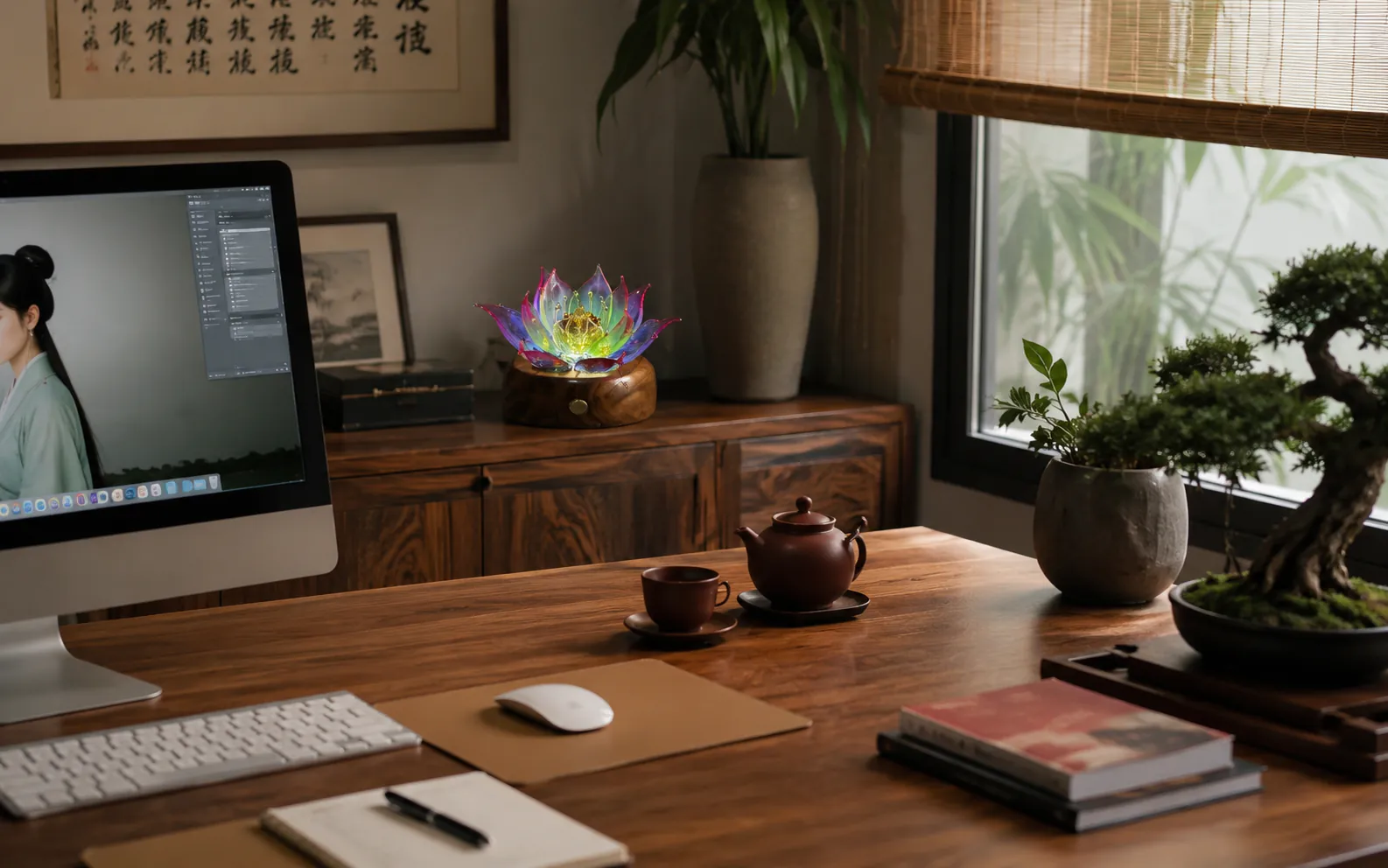
Instead, consider the back corner of a desk, a side return, an adjacent cabinet, or a credenza behind the main chair. From these positions, the object remains visible without competing with equipment used throughout the day.
If the desk is already full, a separate side cabinet is usually more effective than forcing the lotus into a small remaining gap.
Use It as a Visual Resting Point
Screens demand sustained attention and create a flat, luminous visual field. Consequently, a physical object placed outside the screen area can provide a different point for the eye to return to.
The layered glass, organic petal outline, and changing reflections make a lotus useful as a visual anchor within a study. However, it does not need to be brightly illuminated during working hours.
Even in its unlit state, the relationship between glass, wood, and natural light can provide a visual contrast to the screen.
This idea is explored further in Why the Eye Needs a Place to Rest , which looks at how stable objects can create a visual resting point outside the screen.
Place It on a Side Cabinet or Back Credenza
A side cabinet or back credenza is particularly suitable in a larger home office.
In this position, the main desk stays clear while the lotus remains part of the room’s visual field. In addition, it can sit comfortably alongside books, framed artwork, a ceramic vessel, or a plant.
Still, keep the grouping restrained. A lotus, a small stack of books, and one taller object are often enough. The goal is not to build a symmetrical display, but to create a small arrangement with variation in height, material, and outline.
Glass Lotus Light Placement in a Living Room
Compared with a bedroom or study, the living room offers more possible surfaces. However, it also presents a scale challenge: a small glass object can feel lost when placed alone on an oversized cabinet or surrounded by much larger furniture.
On a Console Table or Sideboard
For this reason, a console table or sideboard is one of the most versatile positions for a glass lotus light.
Typically, it provides enough depth for the base, keeps the object away from high-traffic surfaces, and allows the lotus to be viewed from several points in the room.
Rather than placing it directly in the middle, position it slightly off-center. Then, use a small stack of books, a low ceramic bowl, or a framed piece of art to provide balance without creating a formal, symmetrical arrangement.
Meanwhile, the lotus should remain the most detailed object in the grouping. Taller objects are usually better placed slightly farther away so they do not overlap the petals.
Beside a Sofa or Reading Chair
Alternatively, a side table near a sofa or reading chair creates a more intimate placement.
This position allows the lotus to be seen at close range and makes the glass details easier to appreciate. However, the table still needs to remain useful for a cup, book, remote control, or phone.
Therefore, place the lotus toward the back or side of the table and leave part of the surface open. Avoid centering it on a very small table if doing so removes all practical space.
Although the light can contribute to the evening atmosphere around the seating area, it should not replace a proper reading lamp.
On an Open Shelf
An open shelf can also work if it has enough height, depth, and surrounding space.
In contrast, a tight cubby can make the flower appear compressed, especially when the upper petals nearly touch the shelf above. Furthermore, restricted space can reduce the effect of the internal light.
For the best result, choose a shelf that allows the full silhouette to be seen from the main seating position. The front button should also remain accessible.
Similarly, avoid placing the lotus behind glass cabinet doors if reflections prevent the petals from being seen clearly.
Create a Small Material Grouping
The walnut base allows the lotus to sit naturally beside other tactile materials.
- a linen-bound book;
- a low ceramic bowl;
- a stone tray;
- a small wooden object;
- a simple glass vessel.
These materials do not need to match in color. In fact, a restrained contrast between glass, wood, ceramic, fabric, or stone often gives the lotus a clearer place within the room.
Most importantly, the arrangement should still feel usable and easy to maintain. A living room surface does not need to become a permanent display installation.
Match the Placement to the Scale of the Surface
In addition to location, the size of the surrounding furniture changes how the lotus is perceived.
For instance, a glass lotus placed alone in the center of a very large sideboard may appear disconnected from the rest of the room. In that situation, create a small grouping within one section of the surface rather than trying to fill the entire cabinet.
On a small table, by contrast, reduce the number of surrounding objects and preserve enough space for normal use.
| Placement | Works Best When | Avoid |
|---|---|---|
| Bedside table | The surface remains usable | Placing it near the edge |
| Study desk | It sits outside the main work area | Blocking screens or papers |
| Open shelf | There is enough height and space | Tight, enclosed cubbies |
| Console table | It is grouped with one or two objects | Filling the entire surface |
Furthermore, background contrast affects how clearly the petals can be seen.
For example, a multicolored glass lotus such as Prism Lotus often stands out against warm wood, cream walls, deep brown furniture, or other neutral backgrounds. A highly colorful or patterned background, however, may compete with the pink, violet, green, and gold tones in the petals.
Ultimately, the goal is not to match every color in the flower. Instead, make sure the outline and main color transitions remain visible.
Sculptural Light Is Not Task Lighting
Its primary role is to illuminate the glass structure itself and add a localized glow to the nearby surface.
It is not designed to replace:
- a reading lamp;
- a desk lamp;
- a ceiling light;
- the main lighting source in a bedroom or living room.
Therefore, this distinction is important when deciding where to place it.
A reading lamp needs to direct useful light onto a book or work surface. By contrast, a sculptural light creates atmosphere, draws attention to material and form, and changes how a small area of the room feels after dark.
If you are considering this type of lighting more broadly, see our guide to choosing a sculptural light for your home , including size, materials, brightness, tabletop placement, and decorative glow.
During the day, meanwhile, the lotus continues to function as a handmade glass object. That is why the placement should still make sense when the internal light is turned off.
Common Glass Lotus Light Placement Mistakes
Placing It Too Close to the Edge
A decorative object with a glass flower should not sit where it can be easily knocked by a hand, sleeve, bag, or passing person. Therefore, move it far enough inward that normal use of the table does not create unnecessary risk.
Crowding It With Too Many Small Objects
A dense collection of small ornaments can hide the petal outline and make the surface difficult to use. Instead, remove objects that repeat the same visual scale without adding a clear purpose.
Treating It as the Room’s Main Light
A lotus light does not provide the broad or directional illumination required for reading, working, or lighting an entire room. For this reason, use it alongside the room’s functional lighting rather than instead of it.
Hiding It Inside a Narrow Shelf
A shelf that is too tight can make the object look compressed and prevent the light from reaching the surrounding space. Consequently, choose an open position with enough clearance above and around the petals.
Leaving It in Prolonged Direct Sunlight
Strong direct sunlight may create distracting glare and make the glass colors difficult to read. In most cases, a place with soft natural daylight is more suitable than a surface exposed to intense sun for many hours.
Choosing a Position That Only Works When Illuminated
The lotus should not rely entirely on darkness to look considered. Therefore, check the placement during the day as well. The flower, base, and surrounding objects should still form a coherent arrangement when the light is off.
A Quick Room-by-Room Checklist
Bedroom
- Use a stable bedside table, dresser, or low cabinet.
- Keep the touch button easy to reach.
- Leave room for a phone, book, and water glass.
- Use a separate reading light when needed.
Study
- Keep the lotus outside the main work zone.
- Make sure it is visible from the seated position.
- Avoid blocking screens, paperwork, or equipment.
- Leave enough space around the petals.
Living Room
- Consider a console, side table, or open shelf.
- Group it with only one or two supporting objects.
- Check its appearance in daylight and evening light.
- Avoid letting it disappear on an oversized surface.
Choosing the Lotus After Choosing the Placement
Once the placement has been decided, selecting the right glass lotus often becomes easier.
After all, background color, furniture material, available surface area, and viewing distance all influence which colors feel most natural in the room.
Prism Lotus, for example, contains violet, pink, green, blue, and warm gold tones. In the placement examples shown here, those colors become easier to read against neutral walls and walnut or medium-toned wooden furniture.
A quieter bedroom may call for a softer visual contrast, while a larger living room can accommodate a more colorful focal point.
For a broader comparison of color, brightness, and collection differences, read How to Choose a Glass Lotus Light for Your Room .
Final Thoughts
In conclusion, the best place for a glass lotus light is not necessarily the most prominent position in the room.
Instead, choose somewhere stable, visible, and easy to use without interfering with the main purpose of the surface. With enough space around the petals, the handmade glass structure remains clear; meanwhile, a natural viewing angle allows the object to become part of the room rather than a separate display.
Most importantly, a successful placement works in daylight and after dark. During the day, the lotus contributes color, glass texture, and material contrast. In the evening, its internal light adds a smaller, more localized layer of atmosphere.
Frequently Asked Questions
Can I place a glass lotus light on a bedside table?
Yes, provided the table is stable and wide enough to hold the walnut base safely. Place the lotus toward the inner or rear part of the table and leave space for daily objects such as a phone, book, or water glass. It should not sit close to the edge.
Can a glass lotus light be used as a reading lamp?
A glass lotus light is better understood as sculptural ambient lighting. It illuminates the glass and adds a localized glow, but it does not provide the focused brightness required for comfortable reading. Therefore, use a separate reading lamp when stronger directional light is needed.
Where should I place a glass lotus light in a living room?
Suitable positions include a console table, sideboard, sofa-side table, or open shelf. Ideally, choose a location where the full petal outline remains visible and the object is not surrounded by too many decorative pieces.
Does a glass lotus light need to remain close to a wall outlet?
This depends on the base design. 9Purple Glass Lotus Lights use a rechargeable base, so the object does not need to remain permanently connected to a visible cable during use. Nevertheless, it should still be placed somewhere practical for occasional charging.
Should the lotus face directly toward the room?
Not necessarily. Instead, rotate the flower so that its most complete petal arrangement is visible from the main viewing position. A slight angle often looks more natural than positioning the lotus perfectly square to the furniture.